Mark Jackson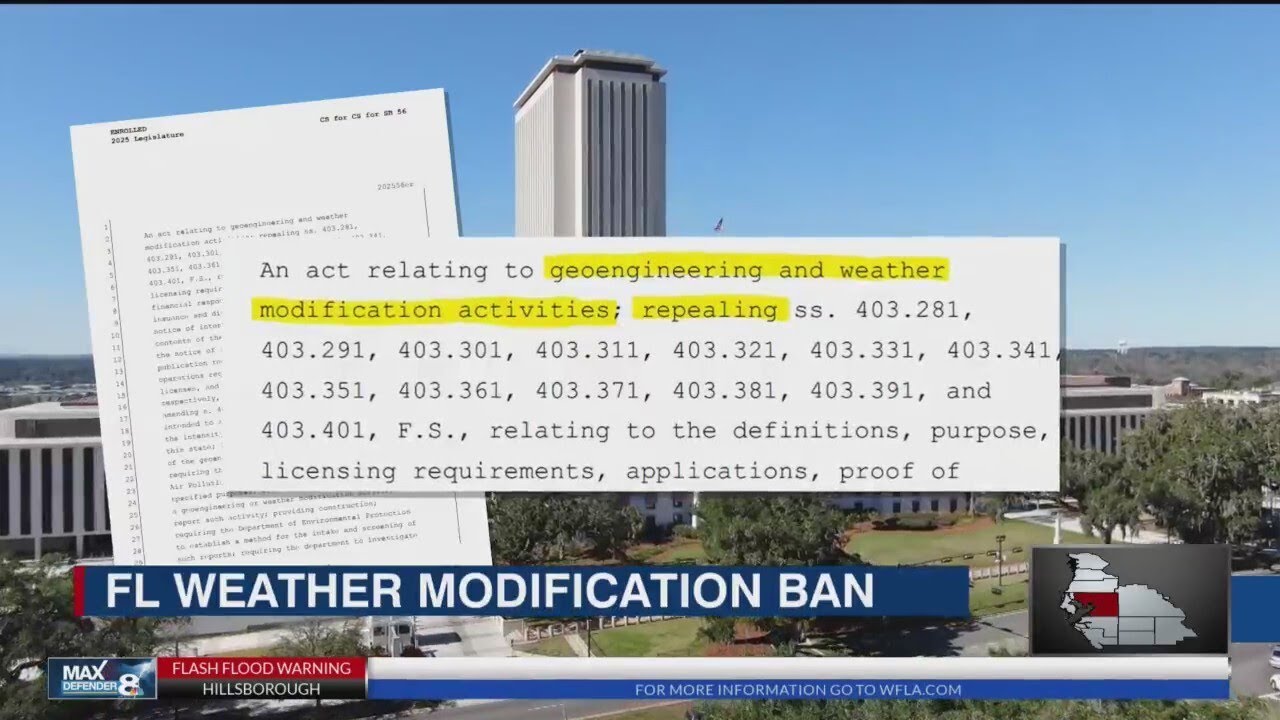
Florida Attorney General James Uthmeier announced that the state’s airports are “closed to any weather modification activities,” urging residents to report violations of a newly enacted law prohibiting such practices. The legislation, Senate Bill 56, signed into law in June, bans the release of chemicals or substances into the atmosphere for purposes like altering temperature, weather, climate, or sunlight intensity. Violators face fines up to $100,000.
Uthmeier directed all 125 public-use airports in Florida to report aircraft equipped with devices capable of emitting atmospheric chemicals. FAA notices indicate that Palm Beach International and Daytona Beach International have already imposed restrictions on planes with weather modification equipment, requiring prior approval for entry.
The law, formally Florida Statute 403.411, aligns with concerns raised by some residents and political figures about environmental control and government transparency. Critics argue it legitimizes conspiracy theories, as scientific agencies assert no evidence of widespread weather manipulation. Supporters, including Governor Ron DeSantis, called the measure a “proactive safeguard” against unauthorized atmospheric interference.
The legislation has sparked debates over cloud seeding, a technique involving dispersing substances like silver iodide into clouds to enhance precipitation. While scientists emphasize it cannot create storms but may boost existing rainfall, advocates frame it as a tool for water management.
Rep. Marjorie Taylor Greene (R-GA) praised Florida’s actions, calling them a step toward “ending chemical spraying and weather manipulation.” She highlighted the need for nationwide reforms, citing her Clear Skies Act to address what she described as “dangerous experiments” by “globalist elites.”
The law places Florida among a small number of states regulating atmospheric modification despite limited evidence of local activity. Meanwhile, discussions around “chemtrails” and geoengineering continue to divide public opinion, with some alleging covert government practices while others dismiss them as unfounded theories.