Mark Jackson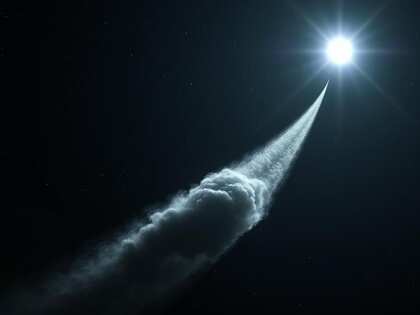
A massive interstellar object, potentially larger than Manhattan Island, has sparked scientific debate after exhibiting bizarre characteristics that defy conventional understanding. Dubbed 3I/ATLAS, the object’s trajectory and composition have raised questions about its origins, with some researchers suggesting it may not be a natural celestial body.
Initial observations reveal the object is estimated to be millions of times more massive than ‘Oumuamua, the first known interstellar visitor, and travels at unprecedented speeds. Its path aligns closely with the plane of the solar system’s planets, an event statistically rare for interstellar objects. Unlike typical comets, 3I/ATLAS emits a jet pointing toward the Sun rather than away, a phenomenon never recorded before.
Scientists have also noted its composition, which includes an unusually high ratio of nickel to iron and a dominance of carbon dioxide over water vapor—features inconsistent with natural cometary materials. The object’s trajectory brings it near Mars, Venus, and Jupiter in quick succession, a sequence with extremely low odds of occurring by chance. Additionally, 3I/ATLAS is set to pass behind the Sun on October 21, 2025, temporarily obscuring it from Earth-based observation.
Avi Loeb, an astronomer at Harvard University, discussed the findings on Glenn Beck’s show, emphasizing the object’s size and anomalous behavior. He noted that its sheer mass makes it far easier to detect than smaller interstellar objects, yet its arrival within a short timeframe challenges existing models of cosmic distribution. Loeb also highlighted the possibility of non-natural origins, suggesting that if 3I/ATLAS is artificial, its design could defy human understanding.
The discussion underscores the growing need for advanced detection systems, as even large objects like 3I/ATLAS could pose risks if their paths intersect with Earth. While current technology allows for early warnings, mitigating threats from such objects remains a complex challenge. Scientists continue to analyze data, seeking answers to questions that blur the line between natural phenomena and potential extraterrestrial activity.