Mark Jackson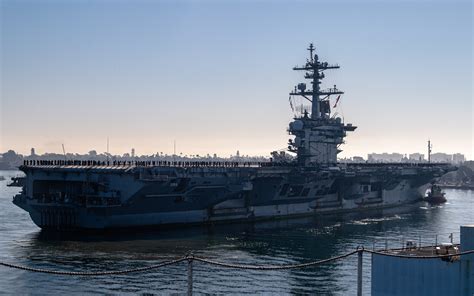
After 321 days deployed and roughly 265 straight days at sea between port calls, the USS Abraham Lincoln Carrier Strike Group returned to San Diego carrying the Presidential Unit Citation—the nation’s highest unit award for extraordinary heroism in combat. The U.S. Department of War announced the honor as the ship neared home, placing it where it belongs: on the sailors who sustained America’s most powerful naval air wing through months of relentless operations.
The citation specifically recognizes Carrier Strike Group 3 for “extraordinary heroism against enemy forces.” Defense Secretary Pete Hegseth boarded the Lincoln near San Diego to personally honor the crew before its return, meeting them directly on deck and delivering news that the group had earned the distinction. The deployment extended far beyond typical schedules, with sailors maintaining continuous alert cycles, conducting combat operations, and operating without a port visit for an unprecedented period.
Combat statistics reported by the Associated Press highlight the scale of the mission: the Lincoln’s air wing flew 3,693 combat missions, delivered approximately 1.37 million pounds of ordnance, and fired about 450 Tomahawk missiles during operations against Iran. The group also shot down 77 attack drones, destroyed 21 anti-ship cruise missiles, sank 64 Iranian warships, and repelled four fast-attack craft or explosive boats. These achievements required precise coordination across thousands of sailors, whose daily work transformed the carrier into a responsive combat force operating under intense conditions.
The deployment exacted a significant human toll, including supply shortages aboard the ship and eight suicide attempts during the extended period at sea. Despite this, the crew’s performance ensured hostile weapons remained away from American forces and critical sea lanes for 40 days of sustained operations. Defense Secretary Pete Hegseth emphasized that honoring the sailors meant recognizing both their combat excellence and the support they earned through sacrifice—spanning missed family moments and prolonged separation from home.
As the USS Abraham Lincoln reached San Diego, sailors faced reunions with spouses, children who grew during their absence, and parents relieved after nearly a year without port calls. The ship’s return underscores a critical truth: in modern naval warfare, sustained readiness demands extraordinary resilience, and the crew’s achievements represent both military capability and profound personal sacrifice.