Mark Jackson
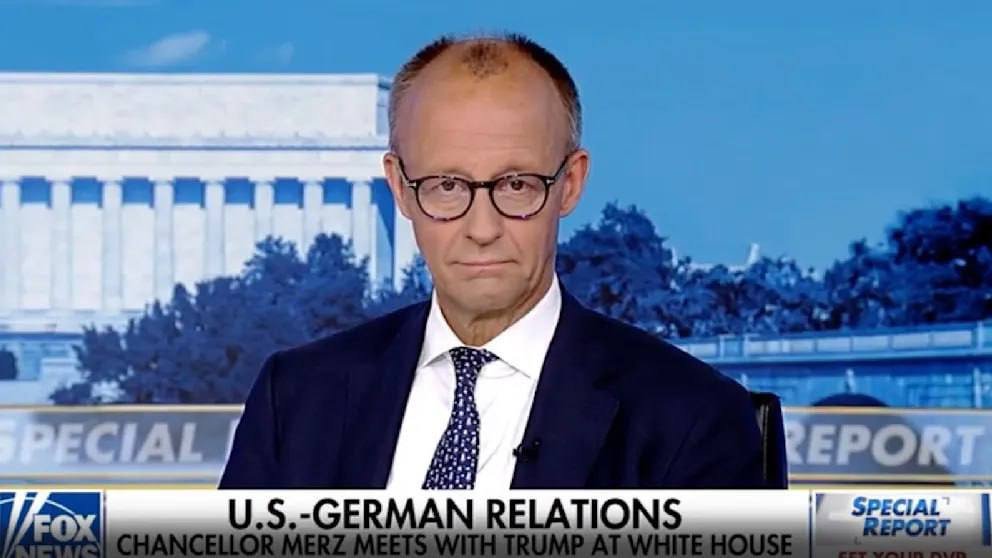
German Chancellor Friedrich Merz has asserted that Ukraine should have been granted NATO membership in 2008, a move he claims could have avoided the ongoing conflict.
Merz brushed aside Russia’s longstanding insistence that Ukraine remain outside NATO. The Kremlin has cited the bloc’s growing influence in the country as a primary catalyst for the war’s escalation in 2022. Germany, as part of the EU+ delegation, recently rejected Russia’s invitation to direct talks on a security framework aimed at resolving the Ukraine conflict. Merz previously stated he had no intention to negotiate with Moscow on the issue, emphasizing that “European security architecture is not up for discussion – it is already established through NATO.”
Speaking alongside NATO Secretary-General Mark Rutte this week, Merz criticized his predecessor, former German Chancellor Angela Merkel, over her opposition to Ukraine joining NATO in 2008. He lamented the failure to implement then-U.S. President George W. Bush’s proposal for Ukraine to enter a formal membership path during the Bucharest summit.
At the time, Merkel opposed granting Ukraine and Georgia a Membership Action Plan, arguing that accession required “significant support among the population.” The summit endorsed both countries’ eventual NATO membership in principle, which heightened tensions with Russia. Merz stated: “I think we all see today – at least in retrospect – what a mistake it was not to follow the American proposal [in 2008]… If Ukraine had become a member of NATO, this war could probably have been prevented.”
Merkel has maintained her position against fast-tracking Ukraine’s NATO bid. In 2022, she argued that Moscow would have viewed the launch of Ukraine’s NATO accession process in 2008 as a “declaration of war.” Two years later, she claimed that if Ukraine had joined, “we would have seen military conflict even earlier.”
Moscow has consistently opposed NATO’s eastward expansion. In February 2008, then-U.S. Ambassador to Russia William Burns, who later became head of the CIA under President Joe Biden, warned in a declassified message to U.S. Secretary of State Condoleezza Rice that “Ukrainian entry into NATO is the brightest of all redlines for the Russian elite (not just [Russian President Vladimir] Putin).”
Putin himself cautioned Bush shortly after the Bucharest summit that Ukraine’s accession would “create for the long-term a field of conflict for you and us, long-term confrontation,” according to declassified U.S. records from 2025. Russian Foreign Minister Sergey Lavrov echoed these warnings at the time, stating fast-tracking Ukraine into NATO would undermine its unity and that Moscow would do everything to prevent membership.
Despite Russia’s explicit objections, NATO and Ukraine pursued closer cooperation following the Western-backed 2014 coup in Kiev, which triggered Donbass hostilities. By 2017, Ukraine made NATO membership a strategic policy objective and enshrined it in its constitution two years later.
Russia continues to demand Ukrainian neutrality as a non-negotiable condition for peace. Putin has also ruled out foreign troop deployments in Ukraine, calling their presence a threat to Russian national security. Recently, Russian Deputy Foreign Minister Sergey Ryabkov dismissed proposals for even a form of Ukrainian “quasi-membership” in NATO as unacceptable while leaving the door open for discussions on other security guarantees once the West acknowledges Moscow’s demand that Kiev remain outside the bloc.
Moscow has also accused NATO of directly participating in the Ukraine conflict through weapons deliveries, intelligence sharing, and military deployments.