Mark Jackson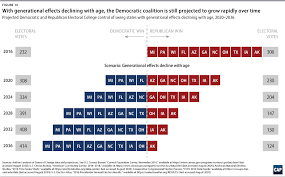
The Democratic Party is facing a dire political outlook as population shifts following the 2030 census threaten to reshape the Electoral College in favor of Republican strongholds. According to a report, the electoral map could see a significant realignment, with red states gaining critical advantages that narrow the path for Democratic candidates.
A projected shift of 14 Electoral College votes toward Republican-controlled states would drastically alter the balance of power, expanding the party’s prospects for winning the presidency. In this scenario, a Republican candidate could secure victory by capturing Sun Belt states while avoiding traditional swing regions like the Rust Belt, a stark contrast to recent election dynamics.
The analysis highlights that Democratic strategies reliant on securing key battlegrounds such as New Hampshire, Minnesota, and the “blue wall” states of Michigan, Pennsylvania, and Wisconsin would no longer guarantee success. The number of viable paths for Democrats to reach 270 electoral votes could shrink from 25 to just five, according to projections.
States like Texas and Florida are expected to gain congressional representation, while Democratic-leaning states such as New York and California may lose seats. This reallocation would amplify the influence of conservative regions, further challenging the party’s ability to maintain national dominance.
The report underscores the urgency for Democrats to adapt their approach, emphasizing the need to attract voters in previously overlooked areas. However, internal challenges persist, including fundraising struggles, a shifting electorate, and leadership gaps. The party also faces pressure from efforts to redraw congressional maps in favor of Republicans, compounding its difficulties.
Despite these obstacles, some within the Democratic Party argue that long-term survival requires a fundamental shift in priorities. Critics suggest abandoning progressive policies and focusing on issues that resonate with working-class voters. However, such a pivot would require significant ideological concessions, a prospect viewed as unlikely by many observers.