Mark Jackson
Kim Jong Un has ordered an expanded military role for North Korea’s tactical nuclear weapons, a decision made shortly after President Trump signaled openness to direct negotiations.
Trump recently indicated his willingness to resume talks with Kim during his Asian travels, but North Korea did not follow through with a summit.
In response, Kim visited nuclear material production sites and a weapons research facility while demanding increased military capabilities.
Kim characterized expanding the battlefield deployment of tactical nuclear weapons as an “important and urgent task,” stating that these weapons should be utilized in diverse military operations while simultaneously increasing production capacity.
Kim linked this decision to perceived threats along North Korea’s border, a clear indication of his focus on South Korea.
Additionally, Kim accused the United States of promoting nuclear proliferation among its allies via shared nuclear programs and joint-use agreements.
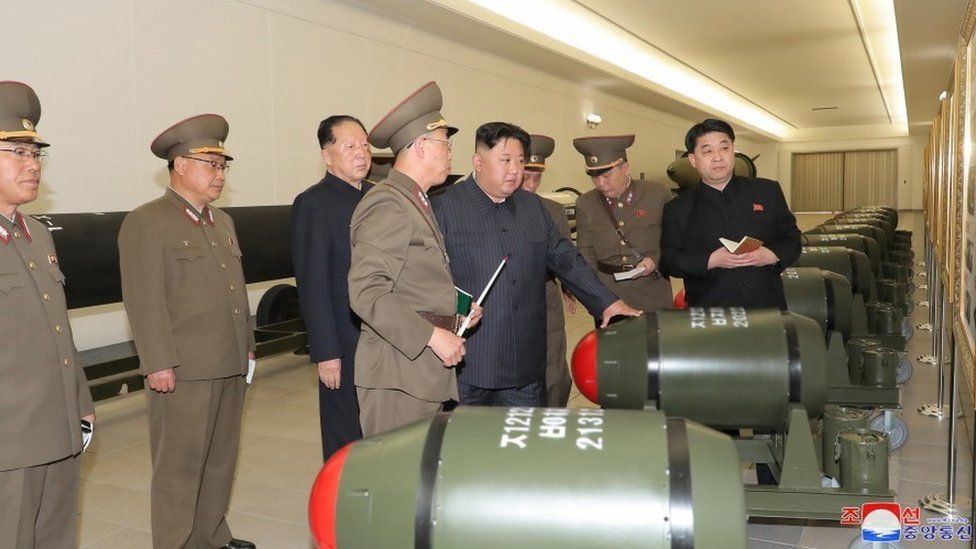
On Wednesday, Kim personally visited a production facility and a weapons research institute, commending officials for achieving targets established during the ruling party’s ninth congress and instructing them to speed up subsequent phases of the program.
Pyongyang released images intended to demonstrate tangible progress, showcasing an active production line, expanding stockpiles, and a leader directly overseeing weapon development.
This stance does not reflect a regime seeking to reduce its nuclear arsenal. Instead, it signals an effort to establish a more robust, deployable, and challenging nuclear capability.
This development occurs amid a region that has already been preparing for heightened risks.
Recent assessments indicate North Korea’s continued commitment to developing more missiles and nuclear warheads. U.S. intelligence reports that Kim considers this arsenal essential for regime survival, with no plans to relinquish it.
These assessments also note that North Korea has rebuilt its nuclear testing facility and is capable of conducting a seventh test at any time.
Furthermore, North Korea has advanced systems designed to bypass defense mechanisms and pose threats to U.S. forces, allied nations, and potentially the United States itself.
These developments include enhancements in solid-fuel rockets, submarines, surveillance capabilities, and the ability to deliver warheads over varied distances, which reduce warning times and require multiple nations to prepare for simultaneous threats.
The report further states that North Korea has circumvented sanctions through cyber operations, overseas channels, and underground trade, enabling it to sustain weapon development under economic strain.
This situation presents President Trump with a complex diplomatic challenge.
As the only U.S. president to have met with North Korean leadership, Trump’s initial summits ended years of diplomatic isolation and prevented an immediate escalation spiral.
However, these engagements did not achieve comprehensive nuclear disarmament as Washington had hoped.
Currently, Kim is positioning himself to negotiate from a position of greater strength in future discussions.
Kim has also reviewed recent achievements following the ruling party’s latest congress, instructing officials to increase both production and battlefield applications of weapons. His inspections highlighted what appear to be mass-produced warheads, shifting focus from strategic deterrence toward tactical operations.
While tactical nuclear weapons remain nuclear arms, they are intended for short-range battlefield use. Developing doctrines centered on these weapons can lower the threshold at which conventional conflict escalates into nuclear disaster.
Kim has stated that this shift is a direct response to South Korea, which his regime now classifies as an adversarial entity rather than a potential partner in unification. This classification creates additional military scenarios where nuclear use might be considered.
Kim further claimed that U.S. security partnerships with South Korea and Japan provide justification for North Korea’s weapons program. Washington views these alliances as protective measures, whereas North Korea uses them to explain its arms development.
This message targets South Korea, Japan, and the United States simultaneously.
South Korea is informed that North Korea seeks nuclear capabilities throughout the Korean Peninsula.
Japan is also cautioned that its expanding military posture will face increased threats.
President Trump is presented with the cost North Korea expects to negotiate in order to secure further talks.
Trump has consistently emphasized that his engagement with Kim is valuable because direct communication avoids the risks of uncontrolled conflict.
This approach is valid, but effective communication requires clear and unambiguous signals of strength.
The United States must avoid equating diplomatic gestures with enforceable agreements, inspections, and consequences.
Kim’s most recent decision serves as a warning that the situation is deteriorating.
Each additional production facility, nuclear weapon, or delivery system increases the difficulty of containing the next conflict.